
A red light therapy device may contain hundreds or thousands of LEDs, yet some of them can appear dark when the system is running. This often leads users to wonder whether part of the device is defective.
In many cases, the LEDs that appear to be off are producing near-infrared light. Near-infrared, commonly abbreviated as NIR, lies just beyond the visible red portion of the electromagnetic spectrum. It normally has no color that the human eye can see.
This guide is written for red light therapy users, wellness center operators, distributors and commercial equipment buyers who want to understand what near-infrared light looks like, why 810nm, 850nm or 940nm LEDs may appear dark and how to check a device without relying on visual brightness alone.
Short answer:
Near-infrared light does not have a visible color. It falls just beyond the red edge of the visible spectrum and is normally invisible to the human eye. Some near-infrared LEDs may produce a faint red glow, but that visible glow is not a reliable measurement of their near-infrared output.
Is Near-Infrared Actually a Color?
In ordinary language, color describes how the human visual system interprets visible wavelengths. Red, green and blue are colors because our eyes can normally detect the corresponding regions of visible light.
Near-infrared radiation falls outside that normal visible range. It therefore does not have a visible color, even though it is still part of the broader electromagnetic spectrum.
Describing near-infrared as “dark red” can be misleading. It is more accurate to say that NIR begins beyond the visible red region. A device can emit a meaningful amount of near-infrared energy while appearing dark to the user.
According to NASA’s explanation of visible light , the human eye typically detects wavelengths from approximately 380nm to 700nm. NASA describes near-infrared as the portion just beyond the visible spectrum that human eyes cannot normally see.
Where Near-Infrared Sits on the Light Spectrum
There is no single universal boundary used by every scientific field. Some references place the transition near 700nm, while certain optical standards use approximately 780nm. The boundary should therefore be treated as a practical range rather than a sharp biological line.
| Light Region | Approximate Wavelength Range | Normally Visible? | Relevance to PBM Equipment |
|---|---|---|---|
| Visible red light | Approximately 620–700nm | Yes | Common examples include 630nm, 633nm and 660nm LEDs. |
| Near-infrared light | Often described as beginning around 700–780nm | Normally no | Common PBM examples include 810nm, 830nm, 850nm and 940nm. |
| Mid-infrared | Longer than the near-infrared region | No | Not interchangeable with the NIR wavelengths commonly used in LED PBM devices. |
| Far-infrared | Longer infrared wavelengths | No | Often associated with infrared heating applications rather than standard red and NIR LED PBM. |
The ranges above are approximate. Their purpose is to explain why visible red LEDs look bright while nearby NIR wavelengths may not produce a visible color.
A dermatology overview indexed by PubMed describes photobiomodulation as using visible red wavelengths and near-infrared wavelengths. This is why a product marketed as a red light therapy device may contain both visibly red and invisible LED channels.
Why Do Some Near-Infrared LEDs Glow Faintly Red?
Some users can see a dim red point when looking at an 810nm or 850nm LED. This does not mean that 850nm has become a visible red wavelength.
An LED has a peak wavelength, but its emission is not necessarily confined to one perfectly narrow line. A small portion of its output may extend toward the edge of the visible spectrum. LED construction, optical lenses, ambient lighting, viewing angle and individual visual sensitivity can also affect what a person notices.
Consequently, two NIR LEDs with similar specifications may not look identical to the eye. One may show a weak red point while another appears completely dark.
Why Do Some LEDs on a Red Light Therapy Device Look Like They Are Off?
Professional red light therapy equipment frequently combines visible red and near-infrared wavelengths. When these LEDs are arranged in alternating rows or mixed arrays, the visible red LEDs can appear bright while adjacent NIR emitters look dark.
This pattern can create the impression that every second LED, every other row or part of the bed is not working. Before reporting a fault, check the following:
- Whether the selected program activates both red and NIR channels.
- Whether the equipment offers separate red-only, NIR-only and combined modes.
- Which physical positions correspond to each wavelength.
- Whether the touchscreen or control system shows a channel warning.
- Whether the pattern matches the LED layout provided by the manufacturer.
A dark-looking NIR emitter may be operating normally. However, invisibility should not be used to dismiss every possible fault. If the equipment behaves differently from its manual, produces an error or shows an unexpected pattern, contact the supplier for model-specific verification.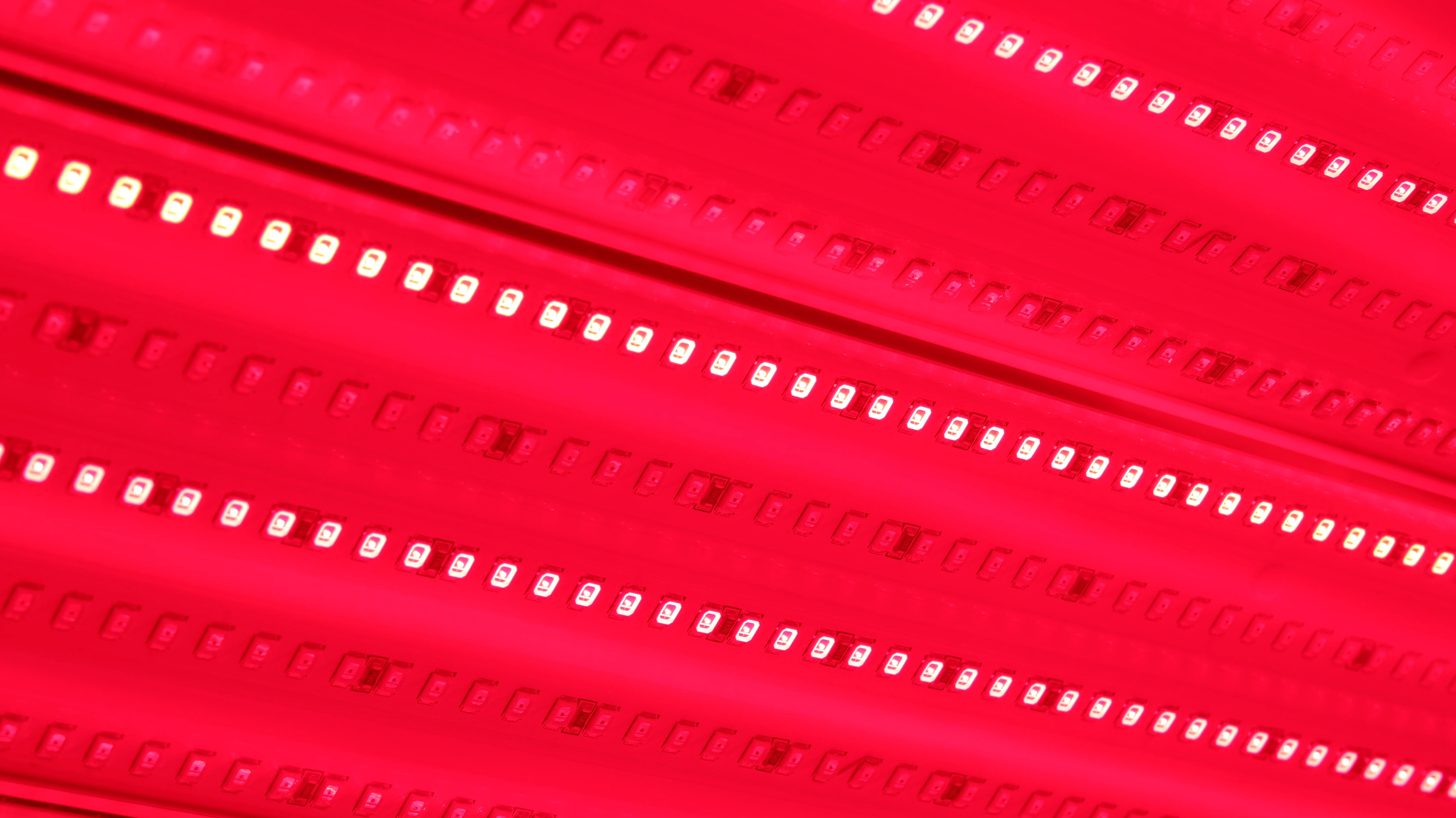
Can You See 850nm or 940nm Near-Infrared Light?
Is 850nm visible?
850nm is normally classified as near-infrared and is outside ordinary human color vision. Some 850nm LEDs may show a faint red point under dark conditions, but many users will see little or nothing.
The amount of visible glow varies by LED design and should not be used to calculate the amount of 850nm energy reaching the treatment area.
Is 940nm visible?
940nm is farther from the visible red boundary and is generally more difficult for the human eye to detect. A functioning 940nm LED may appear completely dark.
The same principle applies to other NIR wavelengths: the eye is not a calibrated optical measurement instrument.
| Wavelength | Light Category | Typical Visual Appearance | Can Appearance Confirm Output? |
|---|---|---|---|
| 633nm | Visible red | Clearly red | No. Brightness alone does not measure irradiance. |
| 660nm | Visible red | Clearly red | No. Instrument testing is needed for output data. |
| 810nm | Near-infrared | Usually invisible or extremely faint | No |
| 850nm | Near-infrared | Usually invisible; a faint red point may be visible | No |
| 940nm | Near-infrared | Normally appears dark | No |
Can a Phone Camera Detect Near-Infrared Light?
Some phone cameras can detect part of the near-infrared spectrum and may display it as a pale purple, white or pink spot. This happens because camera sensors can respond to wavelengths that the human eye cannot see.
However, phone-camera results vary considerably. Many cameras include infrared-blocking filters, and the front and rear cameras on the same phone may respond differently. Camera software, exposure adjustment and image processing can also change the appearance.
A phone-camera check may provide a rough indication that an emitter is active, but it cannot reliably confirm:
- The exact wavelength being emitted
- The irradiance at the treatment surface
- The uniformity of a full-body device
- Whether the output meets the manufacturer’s specification
- The optical dose delivered during a session
Commercial buyers should not accept a phone image as the only proof of wavelength or output performance.
How to Check Whether Near-Infrared LEDs Are Working
- Check the selected program. Confirm that the active program includes the NIR channel rather than visible red light only.
- Review the wavelength layout. Use the manual or manufacturer-provided diagram to identify which LEDs are expected to look dark.
- Compare available operating modes. If the device supports separate channels, compare red-only, NIR-only and combined operation.
- Check the control system. Look for channel warnings, error messages or other unexpected behavior.
- Request model-specific technical information. Confirm the stated wavelengths and LED arrangement with the supplier.
- Use appropriate measuring equipment when verification is required. Wavelength and optical-output claims require suitable instruments and documented test conditions.
Do not open the equipment, bypass its safety system or stare directly into high-output LEDs to determine whether they are functioning. Invisible light should still be treated according to the device’s eye-safety and operating instructions.
What Commercial Red Light Therapy Buyers Should Verify
For a home user, understanding why NIR appears dark can prevent an unnecessary return. For a wellness center, distributor or OEM buyer, the same issue affects staff training, customer communication and after-sales support.
Commercial equipment checklist
- Which visible red and near-infrared wavelengths are included?
- How many LEDs or chips are assigned to each wavelength?
- Can visible red and NIR channels be controlled separately?
- Does the manufacturer provide the LED layout for the exact model?
- At what distance was irradiance measured?
- Was the measurement taken at one point or across the treatment area?
- Can wavelength or spectral test information be provided?
- How is light uniformity evaluated across the bed?
- What instructions are provided for eye protection and session operation?
- How does the supplier distinguish normal invisible NIR output from an actual fault?
Buyers evaluating commercial equipment can review Magique Power’s LED chip and wavelength-control information to understand why wavelength specification and manufacturing consistency matter more than visible brightness alone.
Magique Power offers red and near-infrared light therapy equipment for wellness centers, recovery studios, spas, distributors and private-label projects. Available wavelength combinations vary by model and customization plan, so buyers should confirm the final configuration on the applicable quotation and technical specification.
Businesses planning to introduce a full-body service can also review the commercial red light therapy bed guide for equipment and operational considerations.
Near-Infrared Is Not the Same as Infrared Heat
The word “infrared” covers a broad part of the electromagnetic spectrum. Near-infrared LED photobiomodulation should not automatically be treated as equivalent to an infrared sauna or infrared heat lamp.
These systems can differ in wavelength range, heat generation, delivery method, intended use and operating protocol. A device producing invisible NIR light does not necessarily need to feel intensely hot in order to be operating.
For a broader explanation of LED sources, read What Kind of Light Bulb Is Used in Red Light Therapy?
Frequently Asked Questions
What color is near-infrared light?
Near-infrared light does not have a visible color. It lies beyond the red edge of the visible spectrum and is normally invisible to human eyes.
Is near-infrared light red?
No. Near-infrared is adjacent to visible red on the electromagnetic spectrum, but it is not a visible shade of red. Some NIR LEDs may produce a faint red glow at the edge of their emission spectrum.
Why do some red light therapy LEDs look like they are off?
They may be near-infrared emitters. NIR wavelengths such as 810nm, 850nm and 940nm are normally invisible, so a functioning LED can look dark beside a visible 633nm or 660nm LED.
Can humans see 850nm light?
850nm is normally outside visible color vision. Some people may notice a weak red point from certain 850nm LEDs, but this does not provide a reliable measurement of NIR output.
Can humans see 940nm infrared light?
940nm light is normally invisible to the human eye. A working 940nm emitter may appear completely dark.
Can a phone camera test a near-infrared LED?
Some phone cameras can show near-infrared light, but results depend on the sensor, infrared filter and image-processing software. A phone cannot verify wavelength accuracy, irradiance or treatment-area uniformity.
Does invisible light mean the LED is weak?
No. Human visual brightness and near-infrared optical output are different measurements. An invisible NIR source can still produce measurable output, while a visibly bright source is not automatically more powerful.
How can a wellness center confirm that NIR channels are working?
Check the selected mode, compare it with the model-specific LED layout, review the control system and obtain technical verification from the supplier. Formal output verification requires appropriate instruments and documented test conditions.
Conclusion
So, what color is near-infrared light? In normal human vision, it has no visible color. It sits just beyond visible red, which is why 810nm, 850nm and 940nm LEDs may look dim or completely dark even when operating.
Users should not judge a red light therapy device only by how bright it appears. Wavelength configuration, channel control, irradiance, measurement distance, light uniformity and documented quality checks provide more useful information.
For commercial projects, Magique Power can provide model-specific wavelength options and equipment information for wellness centers, spas, recovery studios, distributors and OEM/private-label buyers. Configuration details should always be confirmed for the exact model being evaluated.
References
- NASA Science. Visible Light .
- NASA Science. Reflected Near-Infrared Waves .
- National Institute of Standards and Technology. Infrared .
- National Library of Medicine, PubMed. Photobiomodulation CME Part I: Overview and Mechanism of Action .
